The Aeolian Harp Idea...
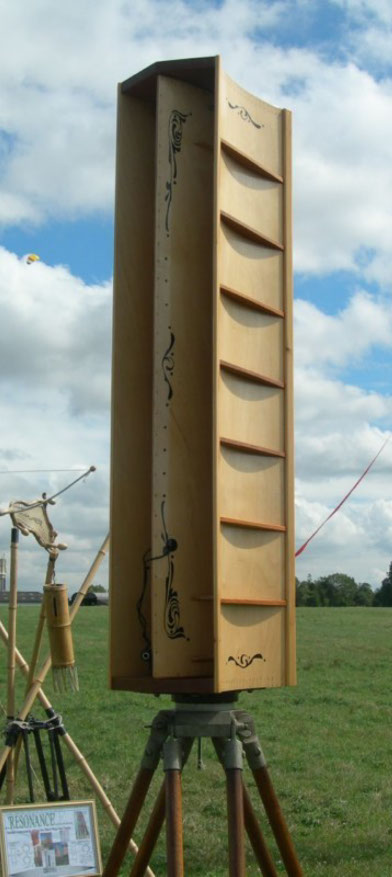
The Aeolian Harp simply consists of a number of strings stretched over a sound box. There are as many theories on the best configuration as there are people who make them. Some sources suggest the use of strings of different diameter tuned to the same note, the second A below middle C, the fundamental, because this allows the chords to stretch to infinity, any fundamental would do. Others say use the same string tuned diatonically and every combination you can think of. The problem of course is, that the sounds produced are not those of the natural vibration of the strings. It is quite different to the notes produced by plucking the strings. It is possible that the sounds can span 5 octaves, but it would be more certain that a couple of octaves could be discernible. So if one does not hear the vibration of the string, then it is clear that something strange is happening.
The method of sound generation is still not clearly understood. Kirchner, noticing that several notes may be heard from the one string, suggested that the string acted like a prism. Since then, there have been many theories propounded. Current thought by Etkin and others in the USA in 1956 suggests that there is an eddy system set up in the air stream as it passes the string. Beyond each string there is a system of eddies turning clock wise and anti-clockwise with a sinuous airflow between them. For a given air velocity the eddy system depends on the diameter of, and the distance between each string. The closer together, the more complex the relationship. The distance between the strings is important. The shorter the vibrating length, the closer together the strings should be. The tension on the strings also has an effect.
How does it sound?
The harp sings, hums and pulsates with the tones rising and falling with the natural variation in the strength and duration of each puff of wind. Because of this, the tones vary from one moment to the next. A fan will obviously make it work, but the sounds produced are monotonous. The fan however is very handy when it comes to tuning the instrument for best effect. One wonders how people ever managed without one. Because you need a few seconds of breeze to allow the sound to develop, an oscillating fan does not work.
It’s in the wind...
A wind speed of approx. 15 KPH over the strings is a reasonable estimate of a good wind, although less will work. There can easily be too much though! The harp is best mounted in a window, either vertically or horizontally and the window is then closed onto it. This causes a choke effect and the breeze pressing on the side of the building, speeds up as it passes through the narrowed opening, so even a fairly gentle breeze will work. The best way to test your window is to open it about 4 cm and hold your hand behind the opening when a breeze is blowing. If you can feel the air-stream jetting on your hand, it will probably work.
On the subject of materials, the use of a furniture grade veneered plywood for the sound box seems to be best and any covers or cowling, which directs the wind over the strings as
aerodynamics do play a part in the operation of the instrument. Guitar strings are expensive when you use 16 of them, so fishing line is used with good results, the wind can't tell the difference. It looks and sounds quite good. You need a mono-filament string. The originators used catgut or wire. There is evidence to suggest that wound strings won't work as the winding apparently effects the airflow.
Other Aeolian Instruments
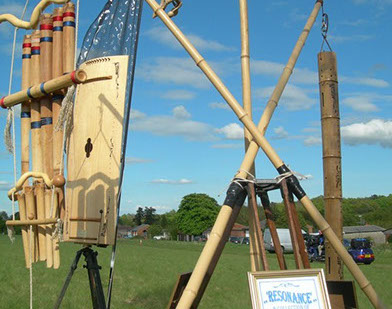
There are many other types and styles of Aeolian Instruments, some of which I have examples of in my display.
The first ones are based around the use of Bamboo.
Bamboo Wind Pipes...
Bamboo is a wonderful natural material with numerous uses. It grows very quickly in many places around the world and comes in various colours, sizes and forms.
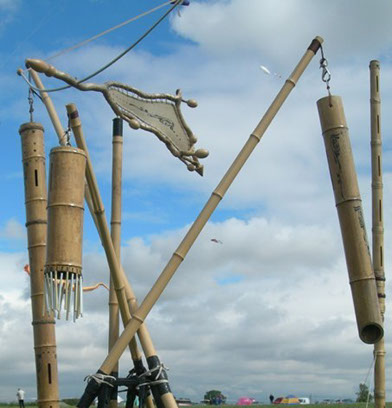
Take a reasonable diameter and length of this amazing material, cut some holes or narrow slots into the chambers between the nodes and allow the wind to blow over them. It can produce some of the loudest and most distinctive sounds within any display. It is the same action making the sounds as when you blow over the open end of a bottle: loud, deep resonating vibrations continually changing as the wind speed and direction alters. Each chamber between the bamboo node points usually has a narrow slot cut into it. This slot has reasonably sharp edges to it produced by 'back-cutting or filing' the bamboo. As each chamber is unique in length and diameter and each slot is also unique in its length and width, no two chambers will produce the same sound, but working as a group, as the wind speed increases, the overall level of sound volume increases. You cannot really 'tune' this sound from each chamber, but it is a very special sound, one of the most distinctive and asked about sounds from the display. It can be heard from a great distance: normally a deep 'howling' or 'roaring' sound. Within a display, these pipes can be set in a vertical or horizontal form, as individual pieces, or made into a group and are sometimes called 'organ pipes' for obvious reasons.
Bamboo Wind Chimes
Bamboo wind chimes are available everywhere nowadays, from craft and garden centres, to market stalls and on-street retailers. They are seen and heard in many places, often within private gardens, with many forms of design, and size, but in all cases, they are just sections of bamboo, either striking each other, or being hit by wind-moved 'hammer' strikers. The wind moves everything within a wind chime, allowing bamboo sections to hit each other, all making sounds, getting louder as the wind increases. Certain tuning is loosely possible for each bamboo section by shaping, cutting or filing away bamboo until the correct 'sound' is produced. The main problem is always in the bamboo itself. It is a natural material and therefore will change as the conditions surrounding it change. It will also crack and split as it dries out over time. All this will change the sounds produced. In general, the larger and thicker the bamboo section(s) used, the deeper the sounds produced.
Other Instruments
Wind Vane Hummers...
These types of instruments again use a bow with a length of tape held under tension and placed in the wind's path. In this case the bow is supported on a pivoting framework of twisted willow.
This can then be decorated and in the same way a weather vane will always turn into the winds path, so will the Wind Vane Hummer. As the tape length is far shorter in this type of instrument than the 'Longstring' static version, it will require a higher wind speed to get the 'string' to vibrate at a pitch that the human ear is able to pick up, but again once it is working, the frequency 'sine' curves can be seen in the vibrating tape. Usually set up as high as possible so as not to be blocked by obstructions, these instruments can produce a loud 'buzzing' sound. As the 'string' length is short, the sounds tend to be of a higher pitch. Designs vary considerably, depending on the materials used to construct and decorate the instrument. The bow can be set in a vertical or horizontal position.
Flutes and Whistles...
Flutes
and whistles are Aeolian instruments that are usually found attached to kites or in the case of some whistles, more usually (in the past) directly to pigeons. In the case of kites, as the kites fly, the wind passing over carefully constructed and tuned shaped openings in wood, bamboo and gourds attached to the kite framework, plays a continuous note or tone. The flute is probably the sole musical instrument that made its appearance worldwide and one of the few musical pieces that came into being in early human history. However, the kite-flute is possibly unique to Vietnam. The Vietnamese kite-flute has a particular structure, unlike all the others of the kite family, and it belongs to the wind-instrument section, as its sound is produced by the inflow of the wind, in harmony with the movement of the kite in the air. Making a kite-flute is no simple matter. If a flute a little bigger than the usual one is fixed on the kite, it will only give out some whisperings. A good flute should produce an uninterrupted stream of sounds and intensity, like that of a gong, a horn, a shell or a bell.
Pigeon whistles are a very small form of wind instrument. There is an ancient tradition of attaching a whistles to pigeons so that when they fly they make music. They are used for pleasure and to keep birds of prey away. In China there is an old tradition to attach little light whistles to pigeon’s tail-feathers that produce a pleasant sound during flight. They have simpler forms like pan-flutes and more sophisticated ones with a body of ornamental gourd-shells, separated in two compartments producing a deeper “male” tone and a higher “female” tone at once. The most complex flutes can omit up to 30 tones in one instrument. There are two distinct types of whistles. Those consisting of bamboo tubes placed side by side and a type based on the principal of tubes attached to a gourd. They are usually lacquered in yellow, brown, red, and black to protect the material from the destructive influences of the atmosphere. These small instruments do require a good and steady breeze to work properly, but can be used in a more decorative style of instrument and are a very unusual thing to see nowadays.
Bamboo 'Longstring' Hummer Tapes...
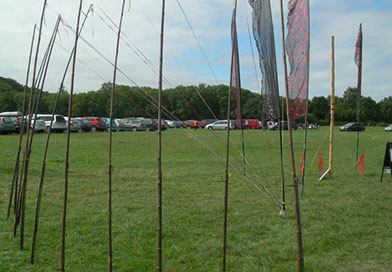
A very simple idea that can be set up in various ways. It uses lengths of thin bamboo poles to form a bow, with thin coloured florist tape as the sounding 'string'. Each tape is usually over 5.0m in length and once set, cannot stop moving even in the lightest of winds. I usually set my bamboo rods in an arc or semi-circle, with all the tapes converging to one ground anchor point. It is one of the few Aeolian Instrument designs that you can actually walk into.
I have seen people react to this idea in various different ways, some even lying down under the tapes, inside the 'instrument, just taking in everything that is going on, sometimes with their eyes shut. Children (and adults) just cannot help but reach out and touch the vibrating tapes! This type of instrument can get very loud as the wind speed increases, while the tapes can show the various stages of the resonating frequency curves very well as they vibrate. Each tape is under a slightly different tension due to the varying bamboo bow strengths and therefore these cannot be 'tuned' in any way. Sounds produced can vary considerably, but in general usually sounds similar to helicopter rotors. This idea is easily reproduced in any location, just requiring something to form a bow and put tension into the string.
Florist tape is easy and cheap to use as well as giving additional scope to allow colour to be added. Also the edges of the tape are not too sharp when vibrating. Something to think about if there are children trying to touch it all the time!